MAJOR WORK TO BEGIN ON CUMBERLAND TRAIL/CHANNEL: CMP PIPE REPLACEMENT

By Emily Stuckey-Treichel

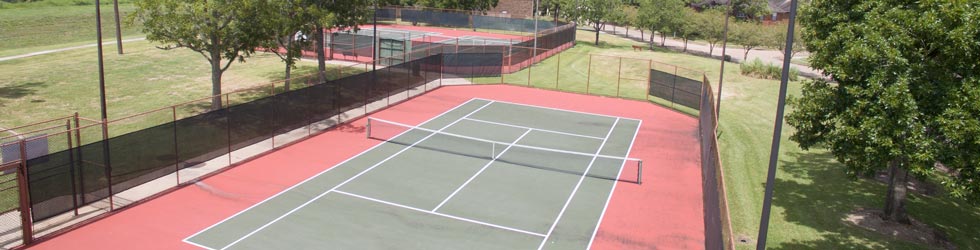
Fort Bend MUD 47 (FBMUD47) will soon begin a corrugated metal pipe (CMP) Replacement Project along the Cumberland Channel and Trail which runs from the asphalt trail, past the tennis courts to Aldridge Drive. Work will be located on both sides of the channel which will impact trail access during the project. There will be large machinery and materials on site and extensive groundwork so we ask the public to respect all safety fences, barricades and warning signs. The District’s contractor estimates the project will take 1-2 weeks to complete. Inclement weather and interference by the public can lead to increased completion time.

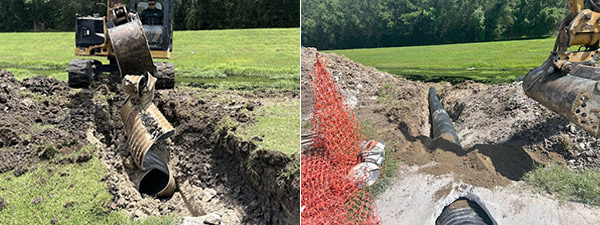
The project is necessary to address erosion and structural failure of three CMPS. The issues are primarily a result of prolonged erosion which wears away the protective interior coating of the pipe, eventually exposing and deteriorating the metal. This allows water to escape through the pipe joints, which can lead to sinkholes and reduced drainage efficiency.

The District’s contractor will cut and remove the damaged concrete inlet structures, extracting the existing CMPs, and hauling off the debris. The contractor will then install new galvanized CMP and place cement-stabilized sand to ensure proper support. Once installation is complete, the concrete inlet structures will be re-poured to restore the original V-shape design consistent with other backslope interceptors.

Each new pipe will feature a polymer coating, providing an added layer of protection from erosion that typically doubles the service life of the pipe. To complete the work, all disturbed areas will be hydro mulched to promote vegetation reestablishment and site stabilization.

The photos below illustrate the type of work to be performed during this project.
WATERLINE FLUSHING NOTICE

Flushing of the District’s water lines will be performed during the weekdays of September 22, 2025 by the District’s water and wastewater operating company, Municipal District Services (MDS). All water mains shall be flushed using each fire hydrant throughout the neighborhood. Flushing shall begin each morning at 8am until 4pm during this week.

FAQs

What is flushing?

Flushing is a process that rapidly removes water from the District’s water piping system, similar to the process of flushing a car’s radiator. Flushing uses water force to scour out materials that accumulate in the District’s pipes. Water pipes are usually flushed by opening fire hydrants, where the discharged water flows off the streets the same as rainwater.

Why are we flushing?

Imagine driving down the road at less than 1-1/2 miles per hour. That is about the rate that water moves through underground pipes. This slow movement causes sediment like rust and mineral particles to build up over time and accumulate along the pipe’s bottom. A buildup of bacteria known as “biofilm” can also coat the pipe’s inner surface. This combination of sediment and bacteria can restrict water flow in the pipes and contribute to the pipe corroding. Rapid water pressure changes, such as water main breaks and the use of fire hydrants, can stir up the sediment and dislodge deposits lining the pipe, resulting in “discolored water” appearance. Periodically flushing water pipes removes the sediment and biofilm buildup, maintains our District’s infrastructure, and increases water quality.

Isn’t flushing a waste of water?

No. Any overall increase in the amount of water used in flushing is a small price to pay in maintaining water quality and the integrity of the piping system.

How will this affect you?

Usually, you will not be aware that flushing is even taking place in your neighborhood. Flushing is conducted between 8 a.m. and 4 p.m. Monday through Friday. Half of the District’s fire hydrants will be opened to flush the water pipes. It takes about 30 minutes to flush each hydrant. While the hydrant is being flushed, the homes on that block may experience discolored water or a drop in water pressure. Your water service should not be interrupted. If you have no water pressure, please notify MDS at 281-290-6500. The only sign that a crew has been in your neighborhood may be standing water in the roadway.

What should you do if you turned on a faucet and the water coming out is discolored?

Should a reddish, yellow, or brown tint to the water appear, do not be alarmed. It is recommended you do not use the water or do laundry for about two hours; this will give the sediment time to settle. After you have waited for this time period, run your faucets for about five minutes to make sure the water is clear. If the water does not clear within a couple of hours, notify MDS at 281-290-6500 24-hours per day. The District will not be responsible for damages to clothing, etc.

DROUGHT CONTINGENCY PLAN (DCP)

Navigating Drought with Missouri City’s Plan

Every year we deal with drought to some degree. Each year varies from little or no rain to replenish water supply to ample rain to decrease concern of water availability. By mandate, the City of Missouri City has a Drought Contingency Plan (DCP) in place to curtail water use during times of drought, water emergency and high usage that require conservation.

Missouri City’s Drought Contingency Plan (“City DCP”) was last amended in 2019 and changes to the plan were approved during the Council meeting on March 17, 2025. There were several significant changes that were implemented into the City DCP plan.

  1. There are four Response Stages that address mild, moderate, severe and emergency water shortages.
  2. The criteria for terminating or rescinding a particular stage has been revised. The new requirements allow for a stage to be rescinded only if ALL triggering conditions have ceased to exist for a time period of 10 consecutive days.
  3. There is now a separation of sections that are dedicated to “surface water” triggers and “groundwater” triggers.
  4. A detailed breakdown of fines and violations is provided within the City DCP.

Fort Bend County MUD 47 (the “District”) is also required to have a DCP. Since the District’s water is supplied directly from Missouri City, the District’s DCP mirrors the current City DCP. This includes the same Trigger Conditions and Drought Response Measures that are included in the City DCP.  This means that when Missouri City activates a particular DCP state, the District will implement the same measures to maintain a unified response within the community.

More detailed information is available at: https://www.missouricitytx.gov/980/Drought-Contingency-Plan and https://www.fbmud47.org/dcp.