
FOG Fats-Oils-Grease

Don’t Clog Up Your Fun: The Truth About Fats, Oils, and Grease (FOG)

Ever wonder where the leftover cooking oil goes after you fry some delicious food? Unfortunately, many people pour it down the drain, not realizing the problems it can cause. Fats, oils, and grease (FOG) are a major culprit behind clogged drains and sewer backups, leading to costly repairs and environmental issues.

Here at Fort Bend County MUD 47, we’re committed to keeping your home’s plumbing healthy and our community’s environment clean. That’s why we’re here to educate you on FOG and how to dispose of it properly.

The Problem with FOG

When you pour FOG down the drain, it cools and solidifies, clinging to the inside of your pipes. Over time, this build-up can cause:

  • Slow drains: FOG clogs can make your sink, bathtub, and shower drain slowly.
  • Sewer backups: If the clog gets bad enough, it can back up into your home, causing a messy and unsanitary situation.
  • Environmental damage: FOG can overflow into storm drains and waterways, harming fish and wildlife.

The FOG Solution: Simple Steps for a Healthy Home and Happy Planet

Here’s the good news – avoiding these problems is easy! Just follow these simple tips for responsible FOG disposal:

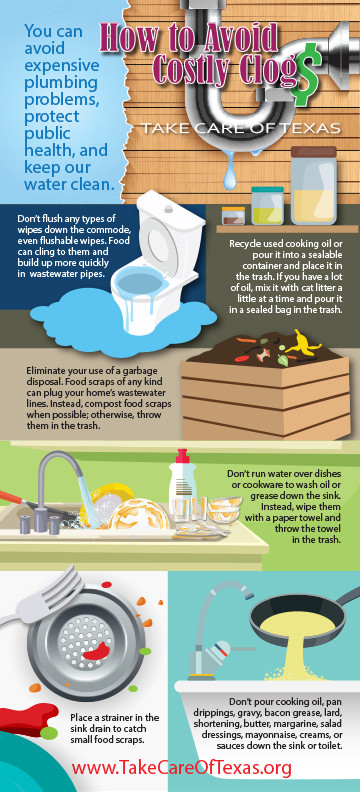
  • Scrape, don’t pour: Scrape excess grease, oil, and food scraps off your plates and pans before washing them. Compost the scraps if possible.
  • Let it cool: Allow used cooking oil to cool completely before disposal. Never pour hot oil down the drain!
  • Wipe it up: Wipe any remaining grease from pots and pans with a paper towel. Throw the paper towel in the trash.
  • Collect and recycle: Save your used cooking oil in a container. Look for local restaurants or recycling centers that accept used cooking oil. You can even make biodiesel fuel from it!

Working Together for a Healthy System

By following these practices, you can help prevent costly plumbing problems for yourself and protect our community’s wastewater system. Remember, what you put down the drain doesn’t disappear – it affects everyone.

(more information available at https://www.sciencedirect.com/science/article/pii/S004896972305386X)

Learn More:

Looking for more information? Visit https://takecareoftexas.org/about-us/blog/dont-put-down-drain for additional tips on FOG disposal and other ways to keep your home’s plumbing healthy. Together, we can create a cleaner, healthier environment for everyone.

Did You Know?

The Fort Bend County Recycling Center provides a location for  county-wide accessibility to residents for recycling of general home and home hazardous waste (HHW). The center is located at 1200 Blume Road, Rosenberg, TX 77471 and telephone number is (281)633-7581.

The Recycling Center accepts a long list of items from plastics to paper to oils to household appliances and more. On their website, instruction is given on how to present the materials and whether there is a fee related to the item.

Don’t pour that crawfish boil or fried turkey grease down the storm water drains! Used motor oil, paint, household chemicals, pesticides, pool chemicals, gasoline, and other hazardous waste are not to be disposed of in storm drains. This contaminates and pollutes our waterways and that affects us all.

If you are unsure of how to recycle or dispose of any chemicals, oils, greases, batteries, paints, household cleaners, fluorescent lighting bulbs (tubes), please visit their website or give them a call. Don’t endanger yourself and family, your household (and its plumbing), or your environment without investigating proper disposal of any item.

Looking for more information? Visit https://www.fortbendcountytx.gov/government/departments/county-services/recycling-center-hhw.
DROUGHT CONTINGENCY PLAN (DCP)

Navigating Drought with Missouri City’s Plan

Every year we deal with drought to some degree. Each year varies from little or no rain to replenish water supply to ample rain to decrease concern of water availability. By mandate, the City of Missouri City has a Drought Contingency Plan (DCP) in place to curtail water use during times of drought, water emergency and high usage that require conservation.

Missouri City’s Drought Contingency Plan (“City DCP”) was last amended in 2019 and changes to the plan were approved during the Council meeting on March 17, 2025. There were several significant changes that were implemented into the City DCP plan.

  1. There are four Response Stages that address mild, moderate, severe and emergency water shortages.
  2. The criteria for terminating or rescinding a particular stage has been revised. The new requirements allow for a stage to be rescinded only if ALL triggering conditions have ceased to exist for a time period of 10 consecutive days.
  3. There is now a separation of sections that are dedicated to “surface water” triggers and “groundwater” triggers.
  4. A detailed breakdown of fines and violations is provided within the City DCP.

Fort Bend County MUD 47 (the “District”) is also required to have a DCP. Since the District’s water is supplied directly from Missouri City, the District’s DCP mirrors the current City DCP. This includes the same Trigger Conditions and Drought Response Measures that are included in the City DCP.  This means that when Missouri City activates a particular DCP state, the District will implement the same measures to maintain a unified response within the community.

More detailed information is available at: https://www.missouricitytx.gov/980/Drought-Contingency-Plan and https://www.fbmud47.org/dcp.

Temporary Free-Chlorine Conversion

The Fort Bend County MUD 47 public water system, (PWS) ID TX0790220 will temporarily convert the disinfectant used in the distribution system from chloramine to free chlorine. The conversion will begin on October 14, 2024 and continue through November 22, 2024. During this period, you may experience taste and odor changes associated with this type of temporary disinfectant conversion.

Public water systems are required to properly disinfect their water and maintain an adequate disinfectant residual in the distribution system. Chloramine, free chlorine combined with ammonia, is widely used as a disinfectant because it persists for long periods while also limiting the formation of disinfection by-product contaminants. Prolonged use of chloramine coupled with other factors that can affect water quality, such as high temperatures or stagnation of water, may result in the growth and/or persistence of organic matter within the pipes of the distribution system, which may hinder the ability to maintain an adequate disinfectant residual. A temporary conversion to free chlorine, partnered with flushing activities, helps to rid distribution pipes of this organic matter and improve the quality of your water overall.

The City of Missouri City, who operates the Mustang Bayou water system for the Fort Bend County MUD 47, has chosen to implement a temporary disinfectant conversion to free chlorine based on the following:With one of two water wells scheduled to be out of service for improvements and to maintain an adequate water supply, your water system will be temporarily interconnected with a neighboring water system which uses free chlorine disinfection. We are required to convert to free chlorine disinfection during the period we use water from our neighboring system until the well improvements are completed and the well is placed back in service.

Please share this information with all people who drink this water, especially those who may not have received this notice directly (i.e., people in apartments, nursing homes, schools, and businesses). You can do this by posting this notice in a public place or distributing copies by hand or mail.

If you have questions regarding this matter, you may contact: Fort Bend County MUD 47’s Operator – Municipal District Services at (281) 290-6500.